Wasps and Hornets in Birmingham: Why Late Spring Is the Window You Don’t Want to Miss
The colonies building in your yard right now are still small. That won’t last long.
Here’s something most Birmingham homeowners don’t realize until it’s too late:
The best time to deal with a wasp or hornet problem isn’t when you spot a massive nest hanging off your eaves in August. It’s right now — in late spring, before that nest gets anywhere near that size.
If you’ve noticed a few wasps buzzing around your porch, poking at your roofline, or hovering near the ground in your yard, that’s not a random encounter. That’s early colony activity. And in Alabama’s climate, “early colony” becomes “serious problem” faster than most people expect.
Why Birmingham’s Climate Is Basically a Wasp Paradise
Alabama doesn’t do gentle summers. The combination of heat, humidity, and long warm seasons that makes Birmingham great for outdoor living also makes it ideal for stinging insects to thrive.
Wasp and hornet queens overwinter and emerge in early spring to start building. Through April and May, colonies are small — sometimes just a handful of workers. But as temperatures climb through June, July, and August, populations explode. A colony that had 20 workers in May can have several hundred by midsummer.
That’s the window. Late spring — right now — is when intervention is easiest, least risky, and most effective.
Wait until August, and you’re dealing with an established, defensive colony that will not appreciate the attention.
The Stinging Insects You’re Most Likely to Find in the Birmingham Area
Not all stinging insects are the same, and knowing what you’re dealing with matters. Our Bees & Wasps Pest Library has a full identification guide for every species common to the Birmingham area — but here’s a quick rundown of what you’re most likely to encounter.
Yellow Jackets
Probably the most problematic stinging insect in Alabama yards. According to the Alabama Cooperative Extension System, yellow jackets are the most aggressive wasps in the state — and it’s easy to see why. They’re quick to sting, and — here’s what catches people off guard — they frequently nest underground. You won’t see a visible nest until you’ve already disturbed it with a lawnmower or a misplaced footstep. They’re also notorious for nesting inside wall voids, attics, and crawl spaces, which makes DIY treatment genuinely dangerous.
Yellow jackets are most active and most aggressive in late summer and early fall, when colony populations peak and food sources start to dwindle. That’s exactly when you least want to discover there’s a nest in your yard.
Bald-Faced Hornets
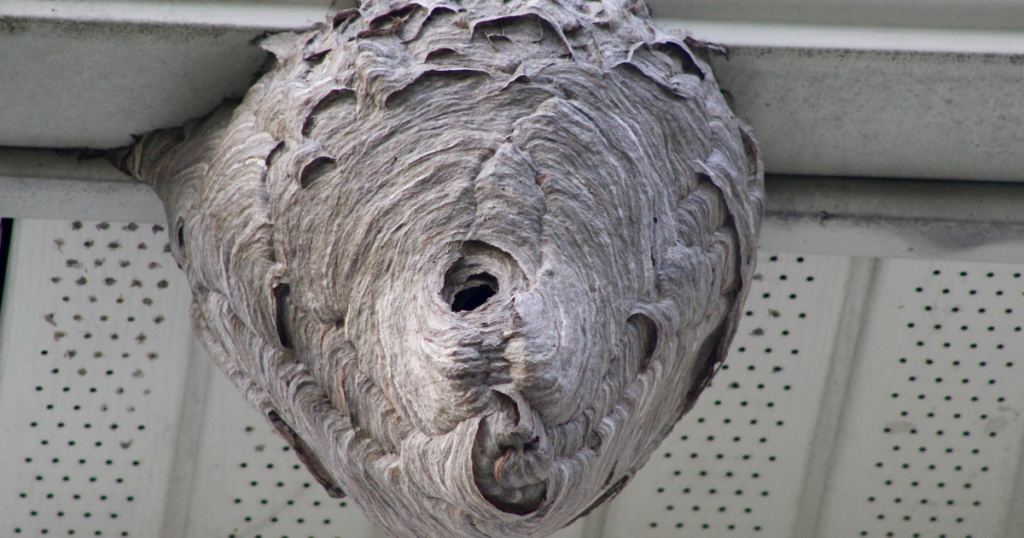
These are the architects behind the large, gray paper nests you sometimes see hanging from trees or overhangs. Bald-faced hornets are extremely territorial and will defend aggressively if the nest is approached. They can sting multiple times, and they’ve been known to target the face and eyes specifically.
The nests start golf-ball sized in spring. By late summer, they can be the size of a basketball. A nest that size contains hundreds of hornets — all of them willing to prove a point.
Paper Wasps
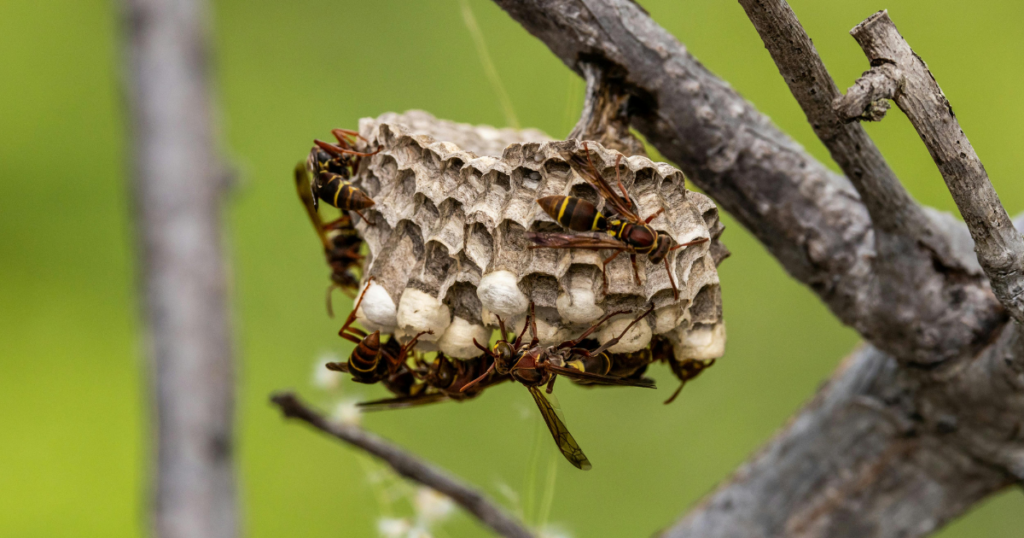
More commonly seen than bald-faced hornets and somewhat less aggressive, paper wasps build the small, open, umbrella-shaped nests you find under eaves, behind shutters, inside grills, and tucked into door frames. They’re not looking for a fight, but they will sting if they feel cornered — and their preferred nesting spots tend to overlap exactly with the places people reach without looking first.
Mud Daubers
Mud daubers are mostly solitary and far less aggressive than the others. They build the distinctive tube-shaped mud nests you’ll sometimes find on walls, under overhangs, or inside garages. They rarely sting and pose minimal risk — but their nests can attract other insects, and many homeowners just don’t want them around.
Signs You Already Have an Active Problem
Sometimes stinging insects make themselves obvious. Sometimes they don’t. Here’s what to look for:
Increased activity near a specific point. Wasps and hornets are creatures of habit. If you’re seeing consistent buzzing around a particular spot on your roofline, fence post, tree branch, or corner of your porch, there’s almost certainly a nest nearby.
Papery or mud structures appearing on your home. New nests that weren’t there in winter are actively being built. Catching them early is the goal.
Activity near the ground. This one’s important. If you see yellow jackets repeatedly entering and exiting a hole in the ground or a gap near your foundation, that’s an underground nest — and it’s one of the most dangerous DIY situations you can stumble into.
Wasps inside your home. Finding wasps inside, especially repeatedly, often means there’s a nest in a wall void, attic space, or soffit that has a gap leading indoors. This is a professional situation, full stop.
Why Right Now Is the Time to Act — Not August
We hear it every summer. A homeowner noticed wasps in May, figured it wasn’t a big deal, waited, and by August had a nest the size of a soccer ball and a family member with a sting allergy standing nearby.
Here’s the reality of the seasonal timeline in Birmingham:
April–May: Queens emerge and begin building. Colonies are small. This is when nests are easiest to locate, treatment is safest, and populations haven’t built up defensive numbers yet.
June–July: Colony growth accelerates. Nests become larger and more visible. Worker populations grow. Sting risk increases significantly.
August–September: Peak population. Maximum aggression. Yellow jackets in particular become territorial and irritable as the season wears on. This is when most stinging incidents happen.
October–November: Queens leave to overwinter. Workers die off. The immediate threat fades — but queens that survive will start new colonies in the spring.
Treating in spring doesn’t just solve this year’s problem more safely. It disrupts the cycle before it gets out of hand.
Why DIY Treatment Often Makes Things Worse
The hardware store sprays aren’t useless — for a very small, accessible paper wasp nest that you can treat from a distance at night, they can work. But there are serious limits.
Underground yellow jacket nests are genuinely dangerous to treat without professional equipment and protective gear. Disturbing an established colony without fully eliminating it typically makes the surviving insects more aggressive, not less. Wall-void nests treated with store-bought sprays often result in wasps finding new exit points — sometimes inside the home. And if you’re treating a bald-faced hornet nest of any significant size, the risk-to-reward ratio of doing it yourself is not in your favor.
Licensed pest control technicians have the training, protective equipment, and products to treat stinging insect problems thoroughly and safely — and more importantly, to locate nests you might not even know are there.
Don’t Wait Until Someone Gets Stung
Stinging insects send hundreds of thousands of people to emergency rooms in the US every year. For people with venom allergies, a single sting can be life-threatening. Even for those without known allergies, a surprise encounter with an established colony — from a lawnmower hitting an underground nest, or a child running too close to a roofline — can result in multiple stings before anyone has a chance to react.
The good news: this is a very preventable situation. The warm-season activity happening in Birmingham yards right now is the window to act before the problem grows into a real risk.
At Athena Pest Control, we know what stinging insects in Birmingham look like, where they hide, and how to eliminate them safely — before summer turns your yard into a hazard zone.
If you’ve seen activity around your home, don’t wait. Contact our team today and we’ll take a look before the season gets away from you.